The most radical existential experience in the form of drawing was the 1987 performance Oberwasser (Being Held in Water). Swimming, the artist drew a 100-metre-long strip of white paper through the trough of a ship lift, transforming it into a line.
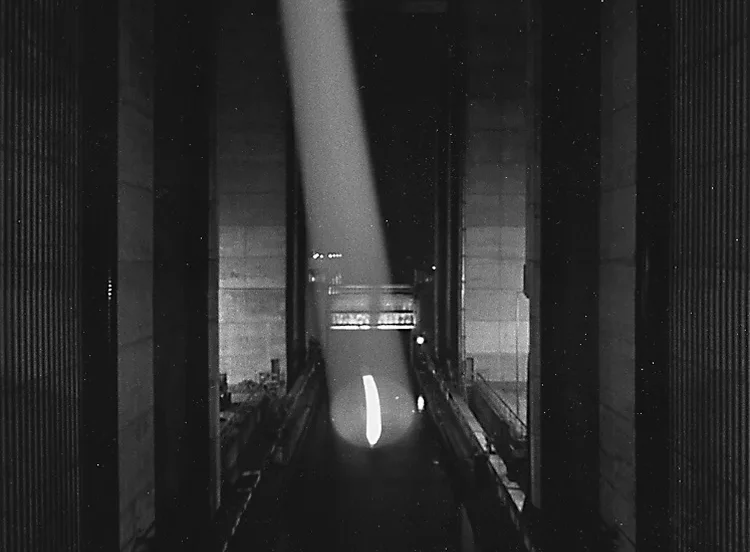
To swim while hovering, and to be alone in cutting, crystalline cold—not a bath, this, not a drawing, not an image, no: beyond land and image, in the water, *being sublated*, as Hegel would have it. Or otherwise: the most immediately apparent movement is perceived less than that of its traces: I do indeed swim horizontally through the lengthwise trough, the water-coffin, and experience it, the space in between, as though it were the actual space, traversing me. Yet what I make visible becomes infinitely more visible through the technique of the cut: the simply cruel, skyward-rising passage, the engineered lifting of the coffin, creates visibility and grants even a portion of the invisible that same visibility. And I, too, then, steeply ascending in experience, in silence with myself, in wet-surfaced solitude?
I? In the immediate state of art, I had, after all, made my promise only to impossibility: I swim on in you, I think on, I venture beyond what I can; nothing else is worth it but this attempt to live—uncannily Egyptian, sheer heights rising all around me, I cannot see straight ahead; I swim and see the imagination through its own eyes, keeping it and myself unharmed in the act of sharing. I do not see. You see and I feel—a socialization of the senses, or: if I do not feel, you do not see the whole, the totality, the possible. Which synthetically brings into being the interplay of technical nature and artistic conception and—if it succeeds—even remains sedimented in memory.